Showing posts with label suzi taylor. Show all posts

Sunday, 15 July 2012

New Project....A Taster.....

Well, this week i have been struck down with feeling rather under the weather, but it hasn't stopped any photography progress.  In fact, things are almost snowballing!
Maybe not quite image making, but ideas and creativity have been rather keen to make themselves shown the past week.

To make this a quick update and just a hint of the project ahead....I'll explain it simply.

1. Found a bunch of old negatives slides that belonged to my Grandfather two years ago.  Chances are they haven't been looked since many years before he died.  Unfortunately, there was no slide projector in sight.

2. I visited a bootsale on the off chance of picking up some decor for my new photography studio when I stumbled upon a lovely vintage slide projector!
The man selling it was quite old but to my surprise, didn't actually know what it was.  I paid £7 for it and got the carrying case with that too.  Bargain.  Felt like it was meant to be.

A lovely find


3. On my way home, I couldn't wait to get to a power socket to try the thing out, but I remembered to stop at an old abandoned house on the way home.
I wanted to stop at the house as I had been here easily 10 times before and knew there were some nice vintage signs left getting dusty.  It seemed a sin for them to sit there any longer!
So, i went to the house and one of the garage doors was open.  It had always been closed before.  Curiousity got the better of me and I took a peak inside.

It was a pretty normal garage.  The usual bits and pieces left behind getting rusty and a wide range of creepy crawlies had set up camp.  Nothing that exciting.  I quick scan around I found a few letters, mostly dated 1970.  It was nice to be able to put rough time and a possible name to the person who lived there.
I had photographed two hats that were left on a shelf over a year ago and had always wondered who they may have once belonged too.

Aside that, I turned around and sitting, looking right at me (no, not a spider) but a rotary slide tray for negative projectors!  I couldn't believe it and instantly was intrigued.
I thought about it for a few minutes then picked up the box and opened it.  It was like new under the layer of dirt.

Upon opening the box I saw that every gap in the holder was filled.  It contained photographs!  I could hardly contain my excitement as I just LOVE old images and the mystery that lies behind them, especially in this case.  

4. I made the decision (which probably upon reflection, was not the right thing to do) to take the slide holder.........

My inspiration to a new project.
 

The rest is to follow :)

However, it will be similar to my last previous project "Then & Now" - Check my website for info:


Monday, 2 July 2012

Bootsale Camera 2: The Halina 3000

Been a while since I have done one of these little reports, so thought I would update today with one!

Went to the local town today and the Fairground has returned for it's 'Summer Trading' - If you can call it summer.
If you want to check out some photographs of the fair, check out my account on the brilliantly fun  Instagram (for those using an iPod, iPhone or other Mac devices)
Search: Suzi_nyc
and you will be able to follow my image uploads there :)
Or, if you are using a desktop to browse, visit: http://ink361.com/


Back to the Halina 3000......
It was a rather overcast day, and I was using ISO 400 film to take a few images of streets and shops whilst walking. 
Just a quick roll of film to test the cameras abilities.

I shot on the following settings:
Shutter speed: 1/125
F: 8

The camera was a Halina 3000, a Hong Kong made, compact camera for 35mm film.

Check out more info on the wonderful Camerapedia .


Here is my Halina 3000, it cost me a whopping £1

The results were mixed as halfway through the film, when I wound on to the next part of the negative it sounded as though the teeth on the wheel weren't quite catching the film correctly.
I did however result in some nice abstract looking double exposures.  So not all bad!


Here are the images for those who are fans of Flickr:

Feel free to leave you comments or add, I am only too happy to check out what others in the photography world are up to!


Thursday, 28 June 2012

Shout out for Models / future Models!

Morning guys,

This is just a quick shout out for those living locally to Belfast, Bangor, Co.Down area.

I'm looking to build up my own personal contacts for models that would be interested in photo shoots for prints for their portfolio.

I'm looking to expand my own photography portfolio and I'm concentrating on fashion imagery at this moment in time.

If you, or anyone you may know would be up for putting there name on my list, then please do contact me with the following information and a photograph attached.

Looking both males and females.  All different looks and styles, each person will fit a certain type of theme, so if you aren't contacted, it doesn't mean you aren't on the list!

  • NAME:
  • DOB:
  • LOCATION:
  • INTERESTS:
  • MUSIC:
  • CONTACT DETAILS:
  • jpg. photo attachment.

Please forward information to:
s.taylorphotography@live.com

Tuesday, 19 June 2012

Skate Park Images, First ones!

Today I FINALLY got to get to a local skate park to get some boarding and blading images on the go.  This has been on my list of things to photograph for around a year now, and feels great to have a few new ones to add to the collection.

These were taken at The Bridges Skate Park, Belfast.  Which is free to use and open between 7:30am-10pm.  Everyone of different abilities down there, lots of friendly people too!

Enjoy the images.  Hoping to get some more at this location over the next week or two.


Thursday, 31 May 2012

Back to Cyberspace!

Hey guys,

First of all, I had not realized how long it had been since I have posted here, time has just flown by the past month as I have been busy wrapping up end of year photography projects for college.

All the hard work paid off as I was awarded the Annual Photography prize for my end of year show "Then & Now."

"Then & Now" - SERC Exhibition

It was a series of black and white images, created using a twin lens, medium format camera.  Influenced by capturing the past and mixing it with the present, inspired by old family images I had found.
Needless to say, I'm over the moon!  It's the cherry on the cake to the past few years devoted to photography at college.  So it was nice to put a very happy ending to the whole thing.


The Exhibition this year was a great success, there was a wide range of both artwork and photography, which is always great to see.  


In the meantime, here is a link to Professor Paul Seawright's website: 


Seawright made an appearance at the exhibition to pick the winner and I'm lost for words to have been chosen by someone who is such a credit to the world of photography, and a key player in photography success from Northern Ireland.


I have been on location with a few shoots during May, and have another couple lined up for June.  As promised, there will be a bit on lighting techniques and how the images were created.


Will keep up to date now I have a bit more time to put into the blog!  
Keep posted, I'll keep posting!

Thursday, 12 April 2012

Old Photographs: 2

Hey guys!

It's been a while since I have posted, but I've been away and there are a few images from the trip I will post up here soon.

In the meantime, it's great to say it's finally April and I have a few interesting photo shoots lined up for the next six weeks.  So plenty of tips and advice coming up on location shoots and lighting techniques for those looking to get a bit more advanced in the lessons.

Until then, here's another cool old photograph found in the archives here!

UK Holiday
I'm loving the glasses the woman on the right of the image is wearing! 


Here is a link to my Flickr page to some of the landscape images I took when away.......Hope you enjoy - Any questions, feel free to contact me :)


More posts to follow, so keep updated!

Friday, 30 March 2012

Old Photographs

So!  After unearthing a lot of old photographs, (and I mean a lot) - I have decided to do a post every few days of one of the old photographs.

I'm one of these photographers that is constantly fascinated and amazed at old photographs.  They always leave me wondering.
Who the people were, why they were their, where are they now, are they alive, are they dead, who was standing behind the camera, what was their reasons?
All the questions and chances of getting an answer often, very slim!


So, with that, here is the first image :)  Martin Parr - Eat your heart out!


I love the vibrant colors in the image, the curtains, the shirts, along with the ice-cream and the lady eating it.
It's has classic, Martin Parr written all over it.
Snapshot, color photography.  Showing part of society frozen in time.

I hope that these entertaining and intrigue you as much as it does to I!

Lengthly postings have been slow lately (and I apologize) as I have been busy working on several projects at once and will be doing so until May.  BUT, I will keep you updated and hopefully get a lesson of sorts up after all the hard work is done.

Until then, enjoy some of this vintage imagery! 

Wednesday, 14 March 2012

Flickr Update!

Hey guys,

Just wanted to put a quick post up here to connect you to my Flickr page.

I upgraded (finally!) so will be posting a lot more work up onto there.


Updates include:
  • Bands and live music
  • Events
  • Bar / Club promos 
  • Any personal works / projects

So, check it out and keep posted, as I'll be keeping it as live as possible!


Thanks!

Saturday, 4 February 2012

Photography LESSON 2: How Film Works

This is the second lesson in photography.  I am going to keep the lessons in order, running through all the processes involved in photography.  Hope you guys can learn something useful from it.

LESSON 2:
PHOTOGRAPHIC FILM & HOW IT WORKS

Centuries after the camera obscura was first seen, science had began to find it's way with certain chemicals that were found to be sensitive to light.  This was around the 1830's. 

The film we are familiar with today is made of a strip of plastic, coated with emulsion containing whats known as Silver Halides.  Silver Halide is made up of six different chemicals and, as a group, it creates a compound chemical that is light-sensitive.

Your standard 35mm film in canister
Layers of your black and white film

These silver halide salts are held in place by gelatin in each layer of the film.
Black and white film is usual more basic and made up with one layer of silver salts.

When you expose your film to the light, the salts are converted to metallic silver and a photochemical reaction takes place.  This is what creates you image onto negative.
Layers of a color film - each layer absorbs light as it is exposed when the shutter of your camera is opened.
 Thus, when you push down the trigger on your camera, the click you hear is the shutter opening for a fraction of a second to let light into your camera and to hit your film.
If you have read LESSON 1: The Camera Obscura section of my blog, this image below will be familiar to you.
This time, the wall the image is projected onto, is a small section of the film strip in your camera.


As your film is exposed to light, the chemicals soak up the light and create your negative image


I will talk more about film processing and how you get your final print in the next lesson section of this blog.  In the meantime, here is a bit of an insight on how film was created.


A Brief History of Film and Photography

The two big names in photographic history are British born, Henry Fox Talbot (who was seen as the pioneer of photography) and Frenchman Louis Daguerre.  Both were competing against each other in the 1830's in the race to see who could create an image with the abilities to be reproduced for the masses.

Henry Fox Talbot
 
Talbot used the large, shoe box style camera to create his images.  He discovered that paper could be coated with the silver salts and with several chemical reactions, the image could be 'fixed' and a permanent negative could be made.  This in turn, gave him the upper hand against Daguerre and his images which he fixed onto a silver-plated sheet of copper, much like a mirror- only producing a one of with each image.  These were often referred to as "The Mirror with a Memory" during the 19th century. 
Louis Daguerre
 There are many famous examples of images from both of these men.  Unfortunately for Daguerre, his methods were seen more as a brick wall for image making as he could not make reproductions of his images, unlike Talbot, who created the negative image with his paper and chemical methods.
Here are a few of those famous examples that shocked the world and were a matter of wonder and disbelief to most.  Magic seemed to happen before their eyes as these men created images that would take hours for an artist to draw, in a matter of minutes.

Talbot's - Trafalgar Square, 1843

Talbot's - The Ladder, 1844

Talbot's images were very different to Daguerre's unique images of the time.

Portrait by Daguerre
Portrait of a Boxer by Daguerre


These were known as Daguerreotypes, and are still used today by some artists.  Simply because of the individuality of the image created and the process it takes to produce them.

Perhaps some of the most famous, modern Daguerreotypes today are the ones created by artist Chuck Close.  In 2003 Close captured world famous fashion icon and model, Kate Moss using the Daguerreotype format.
Daguerreotype Kate Moss, By Chuck Close 2003


Daguerreotype Kate Moss, By Chuck Close 2003
Self Portrait from the artist - Chuck Close

There are still many types of film out there today, even though it seems at time we live in an age where digital has taken over.
120mm Film, known also as Medium Format - was a common size used during the 20th Century
Large Format film - an expensive hobby these days!

I'll talk more about film photography, societies and enthusiasts that still use the format in a later article.
Film photography is the true, original and best way to learn about photography and develop your skills.

Although more expensive to have as a hobby, even for a short time, it does pay off.

Hope you have enjoyed the lesson, next up....Film processing and how to do it!


Photography LESSON 1: The Camera Obscura

This is the first part of many lessons in photography to come.
I've been studying photography since 2008 and I know I still personally, have plenty to learn.  I also know that had I been taught certain things in a different order, my photography knowledge would have been pieced together a lot easier and certainly quicker than it was!  So with that, I am going to start from where I wish someone had started with me.
I hope this helps you understand the foundations of photography & why things happen for a reason.


LESSON 1:
THE CAMERA OBSCURA

First things first.  Don't be intimidated by the weird word.  Let me explain.....

Camera is Latin for "room"
Obscura is Latin for "dark"

Photography is thought to have been invented (using that term loosely) around 1893, although the concept of it has been around much longer - This was, and still is, known as the Camera Obscura.
We all know photography as capturing a scene.  Making an image on paper of what we see in front of us.  A way of recording and capturing an event, people, places and things. 
Thus, photography is a method of creating images.  To create an image we need both light and darkness.  Without this, photography would be nonexistent.

So what is the Camera Obscura and what does it have to do with my digital SLR or camera on my phone?  Have a look at this diagram.....
An early sketch to show the technique - 1544
  
All of what we see is down to light and how it travels.  Vision is a rather detailed process to explain, and I'm no scientist, but I'll attempt to break it down and relate it to photography terms.
Take a look at your eye, look at the pupil in the center of it.  This is what lets light in.  Your pupil becomes bigger in the dark because it needs to let more light in. On a sunny day, your pupil will be smaller as you don't need as much light to see.  The same method is applied to the camera obscura to create an image.


The candle labeled A on this diagram is what you see in front of you.  Such as this screen as you read!  Image B is what is received to your retina at the back of your eyeball, and yes, it is upside down.  Your brain then converts the image to the correct way up.  
It is upside down because of the way light travels. 

When light travels, it travels in a straight line.  Therefore, when rays of light are reflected from a bright source and passed through a small hole, it cannot scatter.  It must cross in a straight line and it then becomes an upside down image.

So here you go, the Camera Obscura.....
Imagine a completely dark room, with no light leaking in.  Windows covered in black material, the bottom of doors sealed with tape.  A small hole can then be cut in the black material to let light flood into the dark room.  The scene outside will then appear, as if by magic, upside down, on the opposite wall.
Have a look at this wonderful giant, camera obscura image created in a room using nothing but natural light and a tiny hole.

An image created in a room, Central Park, NYC - By Abelardo Morell

It truly is simple to create with unbelievable results.
This is how we came about creating, natural, raw images.  Nothing used except light and darkness.

Another camera obscura image created by Abelardo Morell - The Eiffel Tower, Paris 1999
Here is the famous light bulb set-up of a camera obscura.  Created in 1991 by Morell to show how the diagrams we have seen can be recreated on a small scale.

Light Bulb, 1991

It really is that simple.

At great artist to check out is Abelardo Morell (who is responsible for most of these images)
 - Born in 1948, Havana, Cuba.  Studying art from 1977, Morell became a Honorary Doctor of Fine Arts in 1997.  His photography work is definitely not one to be missed if you are interested in seeing more of these fantastic images.


The Neighborhood - by Morell

I hope this little insight on how light works and travels has helped you understand the first part of how your images are created.
Portable camera obscuras were created and used by artists, who to capture their image, traced around the projection, off the wall and onto paper. 
A large camera obscura used to create portraits
An artist uses the method to trace his image onto paper
A diagram of the camera above - a mirror is used to project the image onto the working surface

It wasn't until the late 1800's did the idea of capturing these images quickly onto a surface in some sort of permanent fashion come about.  This was through the development of chemicals and their reactions to one another.

I'll talk more about chemicals, film and capturing an image on the next lesson.

Until then, keep an eye out for a step-by-step tutorial on how to turn a room into a camera obscura!
Check out a few of the guys from National Geographic giving it a try.....
National Geographic try out the Camera Obscura


Friday, 3 February 2012

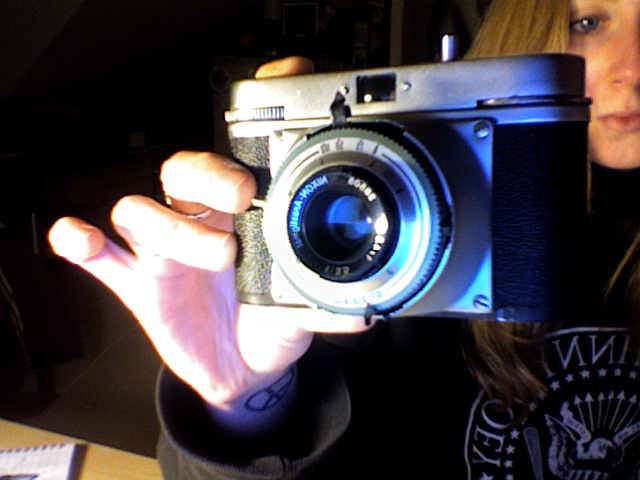
Bootsale Camera - IDEAL COLOUR 35

Hi guys,

I just got my first film developed from this lovely little hand held 35mm German camera.  So, I thought I would post a few of the results and give you a bit of insight to the gem.

The Ideal Color 35mm - Produced in the 1950's in Germany


I picked this sturdy, 35mm up at a car boot sale in Bangor, Co.Down one calm Sunday morning.  The sale wasn't that busy as this was December and it was rather cold by the sea in the morning never mind the rest of the time.
It set me back a whopping £5.00, after a haggle down from £10.  Thus, walking away feeling twice as good.  I was a camera up, and didn't feel as though I had been completely robbed blind.
A quick test saw that the shutter and aperture seemed to be working ok.  We all know there is nothing worse than picking up a broken camera, but you can't go far wrong with old 35mm.  Provided there are no light leaks into the body of the camera, the lens doesn't appear damaged and there's nothing suspicious rattling around inside, then you should be onto a winner.

Film is easily put into the camera - Only issue being, there's no window to show if your film is winding correctly. 
The film I used was a 35mm color Kodak ISO 400, 36exp that thankfully, since the apperance of Poundland in my local town, can be purchased for £1 a roll.  This has been a godsend, as before, ordering batches from e-bay and being constantly involved in bidding wars for cheap 35 mil film is never fun or on ones top priority list when it comes to fun.


I equipped myself with the camera for a day or two over a week and snapped away.  Some shots indoors, some outdoors, daytime, evening & some dimly lit indoor situations.
Club Mono Poster, Belfast City, Northern Ireland.  Taken on an overcast afternoon.
From using a lot of Lomography cameras out and about, I'm a bit out of the way of really taking time over my shots.  Lomography are a photographic society mad about analogue photography and mad in the technique of how their images are taken.  It's all about being spontaneous! - But more on the wonderful world of Lomography on a later post :)


I approached this first film with the 'point and shoot' method.  Mostly for the purpose of getting through a film to see if I had a working camera to add to the collection, or whether it was another e-bay listing for parts.
Stormtroopers & other random Sci-Fi happenings in Belfast City.  Very odd indeed!

The camera feels strong and well built in your hand.  If not, perhaps a little small to grip sometimes, even with my tiny hands!  Otherwise, it does feel rather nuke-proof as I throw it into my backpack, not having to worry about silly plastic attachments protruding and breaking off.
The underground crossing & it's graffiti.  Belfast City, Northern Ireland

The shutter speed is easy as pie to operate.  You are given a choice between 25, 50, 100 and B (for bulb, which is as long as you like)  The aperture operating the same way.  You have F16, 11, 8, 5.6, 4 and 3.5.
Shutter speed and aperture settings are quick and easy.

As I return back to Donaghadee, the winter evening is dim, and the lighting in my room is hardly worth mentioning.  Opening the aperture and moving shutter sppeed to 50 gave slightly blurred results, but they had some character none the less.  Which is the best thing about using this sort of vintage camera.  The element of surprise.
My room.  Picture, wall, flag & bass

I continued to remain snap happy over the next few days.  I headed into the recording studio at college where I used to study music to assist on a few recording sessions.  It was dimly lit for filming in the live room, and even darker in the editing room.
Setting up for a live session & podcast recording.  SERC college, Bangor, Co.Down
A very dim mixing desk and a few of the guys.  Would have said an ISO 800 would perform for this type of low light
Home again, it was time for a quick self-portrait mirror shot, as standard!  The lighting hardly wonderful here as it was the evening.
Self-portrait.  Ideal Color 35mm
Soon enough it was time to get the film developed.  Although I can process 35mm & 120mm myself, I unfortunately didn't have any chemicals for color processing handy at the time, so it was off to the photo lab in Bangor, and negatives are processed there and put onto disk for around £2.50, which is better than paying for a full set of prints!

I was super pleased to see results and the little German 1950's camera is locked and loaded again for use again soon.  Would be a lie to say I wasn't looking forward to it.

Would definitely recommend of of the great, reliable vintage cameras if you are looking something worthy of use, but not exactly a rare find, to add to your collection.
Getting ready to go to processing....it's the Roxy All star style today :)
If anyone is interested on more info on this camera, or any camera for that matter, I strongly recommend checking out 'Camerapedia' - It's part of Wikipedia, so as you can imagine, it's a hive of information, not all of it probably accurate, but a source at least!

Camerapedia's info on the Ideal Colour 35mm

Will post again soon, debating the idea of a bit of a learning topic for beginners and a bit of the history of photography too.....

Laters!